Over the past month, I've talked a lot about different ways to use dice to accomplish different things, particularly with an eye to how the probability distributions of those dice expressions pan out. Every gamer has his or her own preference and much of what I've talked about thus far has been to help me figure out what my own preferences are, particularly since I want a better skill system to use in my DCC games. Here's what I've come up with:
 So, a lot of folks gave Dungeon World a lot of crap and I don't understand it. I think that +Adam Koebel and crew did an awesome job on this game, in particular with their core mechanic: roll 2d6, add a relevant modifier (like Intelligence bonus or Strength bonus) and enjoy the result. If you got a 10 or better, you win, you did it. If you roll from 7 to 9, you succeed, but there's some down side or complication to your success. And so, when we break it down, assuming no bonuses or penalties to the roll, you have a 58.33% chance of succeeding at all, a 16.67% chance of succeeding outright (a complete success without complications) and a 41.6% chance of succeeding with complications. All in all, really nice odds of success. Once we start mucking around with bonuses and penalties, our curves start changing drastically. At "+1," success becomes 72.22% likely, 27.78% chance of succeeding outright and 44.44% likely to achieve a complicated success. Keeping the party going, a +2 bonus makes overall success 83.33% likely (41.67% likely outright and 41.66% likely to be complicated) while a +3 bonus makes overall success 91.67% likely (58.33% outright success chance, 33.34% chance of a complicated success). I like the sound of those odds. You're really quite likely in each chance to roll a "yes, but..." sort of result (with a decreasing chance of complication as skill/bonus increases), which I enjoy. Here we have a super-simple task resolution system strongly influenced by central tendency but that easily accounts for character skill, uses an intuitive roll-high system that helps assign degrees of success and has an integrally-defined success factor (so I know when I roll whether I'm successful or not and don't need to ask the DM). It seems like it has everything I want in a simple resolution system; but wait, there's more!
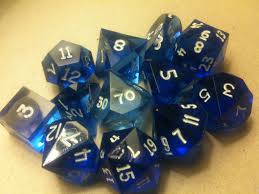 Here's what I think could be more awesome about the DW system: my funky dice. Further, since I'd probably be using this mechanism for Dungeon Crawl Classics, I need it to handle both proficient character actions and non-proficient character actions. In DCC, if your character is attempting something that either (a) is related to the sort of thing that members of your character's class should be able to do (like clerics talking about religion) or (b) is related to whatever that character's profession was at level 0. Normally in DCC, if your character is proficient at whatever you're trying, you roll a d20 and add a relevant ability score modifier (d20 system what?), but if you're not proficient, you roll 1d10 and add the modifier. Target numbers come in the form of Difficulty Classes that go up in blocks of 5 (5, 10, 15 & 20 which amount to easy, average, hard and really tough respectively). Some favorable circumstances may give you a bonus, the sort of thing many of us DCC Judges are starting to want to give Raises for instead**, and some may give you penalties. Why not put these ideas all together with the Dungeon World mechanic to have a super-simple DCC-compatible system?
Here's how it works. For any task in which your character should be proficient, roll 2d6 and add the relevant ability modifier. A roll of 10 or better means an unmitigated success, whereas a roll of 7 to 9 is a success with a complication. If you are not proficient, you suffer a d-1 penalty*** (making the dice roll d4+d6+modifier). Similarly, any advantages your character may gain add d+1 Raises while penalties apply d-1 Lowers. It may be wise (for simplicity's sake) to add Lowers to one of the dice in expression and Raises to the other; thus, modifiers of d-1 and d+1 might result in d4+d8+mod rather than a 2d6 +mod wash. You'd have to throw in a minimum and maximum here as defined by the dice chain (d3 to d30 for the extended dice chain, d2 to d20 for the standard one) to avoid dice that would make Xeno freak out**** and to keep things simple. As long as we keep the success ranges the same (which we will), the players are easily able to figure out whether they've succeeded or not without having to bug the Judge, even if the Judge had to help them to sort out what to roll in the first place.
There are also already skill rules in DCC. Thieves, for example (why do I spend so much of my time thinking about thieves?) already have a very well-defined series of skills with special bonuses to those skills depending on alignment and ability modifiers. At first I'd hoped I could refit these thief skills (and the halfling's sneak skill) into the neat, snug-fitting 2d6+mod roll, but the bonuses here would be huge in many cases, trivializing the skill. Also, many of these thief (and halfling) skills are meant to be opposed in some way and while you could just make it a 2d6+mod vs. 2d6+mod roll-off, it might be a lot simpler to go the intended route and make opposed d20+mod rolls that don't rely on the "degrees of success-o-meter" that 2d6+mod uses. I hate making special cases out of some things, so using one rule for skill checks in one circumstance and another method in another just seems overly complicated.
And so, we're left with a strange circumstance. DCC already has a mechanism for skill checks, but are we necessarily describing a skill check mechanism? It doesn't feel like it to me. I'm less worried about using overt skills like those of the thief and more interested in discussing implicit aptitudes -- unwritten rules about things like "what a haberdasher should be able to tell about a person's station in life as defined by his clothes" or "what a wizard might know about Asashausk-Etlag, Demon Marquess of the Black Spires of Glomphekh, She-Who-Devours-Her-Mates." Realistically, the term "skill check" refers to some degree of explicit, specialized knowledge which is not what we're talking about here. Implied aptitudes come close to the domain of old fashioned "ability checks" (a mechanism I never liked due to its roll-low logic), so why not simply rebrand these rolls as Ability Checks (with proper capitalization)? This makes them a distinct task resolution mechanism than skills and also implies that we can continue to use it for all sorts of things where a character's general (but not explicit) ability and aptitude are being tested. Gone is the "roll 1d20 lower than your ability score" and in its place is 2d6+mod. Bam. Throw in the Raises and Lowers that DCC thrives on and we've got something appropriately flavored for my favorite fantasy RPG. I'll be testing this mechanism in an upcoming DCC funnel that the Metal Gods crew will be embarking upon soon, so within a few weeks, you should be hearing about how this played out.
*"De gustabus non desputandem est" is Latin for, roughly, "you can't argue over flavor." In English, we tend to say "there's no accounting for taste," but that always seems rude to me. I prefer the much more phenomenologically sound Latin version.
** If you haven't been following my Stupid Dice Tricks, you might not know what I mean by a Raise. A Raise means to raise the die type by one along whatever dice chain you're using. If you don't know what a dice chain is, please start over.
*** This is my new notation for Raises and Lowers. A d-1 penalty means to lower the die type by one along the relevant dice chain, while a d+2 bonus would mean to raise the die type by two along the same dice chain.
**** What, people don't get references to classical Greek philosophy these days?
***** This footnote does not exist. I really put it here to show off how ridiculous these footnotes were getting.
- Percentile-based skill systems bore me and don't let me use all my funky dice.
- Roll-low systems are counter-intuitive since bigger numbers should mean better.
- Success based on target numbers can be interesting, but require a lot of thinking on the DM's part and one of two assumptions:
- There are static, universal target numbers to describe how difficult tasks are at absolutely any point in time that simply exist in an objective fashion within the game mechanics.
- The difficulty itself is what matters and the target numbers scale upward with character ability.
- Systems that allow a player to gauge her own success without conferring with the DM to determine success or failure vastly speed up play.
- The system should be able to accommodate differing degrees of proficiency without total rejiggering.
- Being able to discuss degrees of success is always nice. Successes with complications are cool.
- Multiple-dice dice expressions are preferable since they provide solid central tendency.
- I'd like to be able to use different sorts of dice of all sorts. I love my funky dice.
What with these being my own personal preference, they're not up for debate. The Romans used to say "De gustabus non desputandem est," and I'm the one with the gustabus here.* Rather than argue, let's see if we can find the system we're looking for.
A Trip to Dungeon World
Dungeon World Crawl Classics
Here's how it works. For any task in which your character should be proficient, roll 2d6 and add the relevant ability modifier. A roll of 10 or better means an unmitigated success, whereas a roll of 7 to 9 is a success with a complication. If you are not proficient, you suffer a d-1 penalty*** (making the dice roll d4+d6+modifier). Similarly, any advantages your character may gain add d+1 Raises while penalties apply d-1 Lowers. It may be wise (for simplicity's sake) to add Lowers to one of the dice in expression and Raises to the other; thus, modifiers of d-1 and d+1 might result in d4+d8+mod rather than a 2d6 +mod wash. You'd have to throw in a minimum and maximum here as defined by the dice chain (d3 to d30 for the extended dice chain, d2 to d20 for the standard one) to avoid dice that would make Xeno freak out**** and to keep things simple. As long as we keep the success ranges the same (which we will), the players are easily able to figure out whether they've succeeded or not without having to bug the Judge, even if the Judge had to help them to sort out what to roll in the first place.
What It Won't Do
Here's the up side of the d20 system: you only have to remember one rule. Roll 1d20, add some stuff, get better than a particular target number and you win. With this being the core mechanic of DCC as much as it is for D&D (and every other d20 game), keeping this rule consistent means that players have fewer rules to remember. Unfortunately adding this simple task resolution system to the mix means that players have to remember one more thing, so that's less than optimum. Until your players get it, there might be a bit of a learning curve.There are also already skill rules in DCC. Thieves, for example (why do I spend so much of my time thinking about thieves?) already have a very well-defined series of skills with special bonuses to those skills depending on alignment and ability modifiers. At first I'd hoped I could refit these thief skills (and the halfling's sneak skill) into the neat, snug-fitting 2d6+mod roll, but the bonuses here would be huge in many cases, trivializing the skill. Also, many of these thief (and halfling) skills are meant to be opposed in some way and while you could just make it a 2d6+mod vs. 2d6+mod roll-off, it might be a lot simpler to go the intended route and make opposed d20+mod rolls that don't rely on the "degrees of success-o-meter" that 2d6+mod uses. I hate making special cases out of some things, so using one rule for skill checks in one circumstance and another method in another just seems overly complicated.
The De-Complexification Rebrandification
| I missed the opportunity to design a d12-based resolution system. Damn. |
*"De gustabus non desputandem est" is Latin for, roughly, "you can't argue over flavor." In English, we tend to say "there's no accounting for taste," but that always seems rude to me. I prefer the much more phenomenologically sound Latin version.
** If you haven't been following my Stupid Dice Tricks, you might not know what I mean by a Raise. A Raise means to raise the die type by one along whatever dice chain you're using. If you don't know what a dice chain is, please start over.
*** This is my new notation for Raises and Lowers. A d-1 penalty means to lower the die type by one along the relevant dice chain, while a d+2 bonus would mean to raise the die type by two along the same dice chain.
**** What, people don't get references to classical Greek philosophy these days?
***** This footnote does not exist. I really put it here to show off how ridiculous these footnotes were getting.
I am really interested to see how this plays out. If you're read my first issue of Crawl! I tried to tackle skills myself and I admit I wasn't very successful with it--way too fiddly. I actually went back to the simple DCC RPG R.A.W. skills (d10/d20) plus Mod. But I do still use variable d6s behind the screen instead of static 5,10,15,20. I'm pretty adamant about keeping DCC RPG character sheets RAW, and any house rules are behind the screen (in my head, actually, because I don't use a screen) and never on the character sheet. But I have not been happy about the implied "ability check" (because it's not very explicit) rule of role under your stat with a d20. And I do like the DW's math (~60% has always been a magic number for me when it comes to standard task resolution.) But, being the systematic guy I am when it comes to games, I've never been totally comfortable with the story-gamey/arbitrary result "game" between players and gm and having to make shit up-ness of them.
ReplyDeletebtw, I found that for d20/D&D games that use mods that go to +/-3, I think 3d6 (or any dice combo that averages 10/11) works better. For games that mods go up to +2, 2d6 works great. And those that go only to +1 (like LotFP and OD&D) a d6 makes most sense.
So maybe use the base of 2d10, and figure out the target numbers of ~60% chance of succeeding at all, a ~16% chance of succeeding outright (a complete success without complications) and a ~40% likely to be complicated?
Very interesting, and relevant to my interests! I'm not familiar with Dungeon Crawl/DCC, but lately I've been looking at issues like these.
ReplyDeleteI'm making my own system, since I've been dissatisfied with most offerings I've come across. I want a system that is simple and fast, without crossing the line into storytelling type systems. This means I don't have to worry about writing around existing ruleworks, but I'm currently split between using a classic d20 with predetermined difficulty modifier numbers, or a system using multiple dice for each roll, and counting "success dice" (in which case the difficulty modifier would be the number of dice you are allowed to roll). I've been leaning towards the latter for some time now, but I don't want to reduce the game to just using a bunch of d6.
I'll be watching this space. :)
Hmm... Instead of d20, maybe you could go with 2d10. Already with 2d10, you get 11 as the average roll, which matches up with what Dak said, above. A roll of 11 also beats the "standard" DC10 requirement for something that challenges the player. If you apply the raises and drops to that, you'll end up with something that (seems to?) mimic the d20 mechanic, but captures the central tendency. It also would allow more use of d12, so there's that.
ReplyDeleteThe problem with using 2d10 instead of a d20 is that you'd have to re-jigger the DCs (couldn't just stick with the same ones since the probability distribution is different). Nothing an enterprising young statistician (or really anyone) couldn't do.
Delete